0% Complete
صفحه اصلی
/
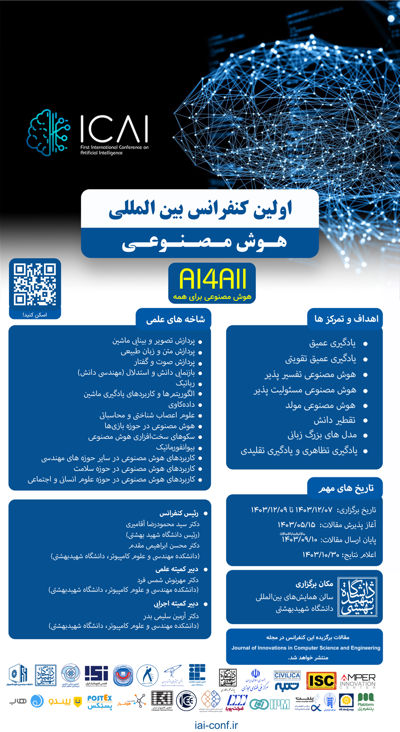
اولین همایش بین المللی هوش مصنوعی
A Hybrid Approach for Intrusion Detection in Computer Systems Using Optimized Deep Neural Networks
نویسندگان :
Yousef Nahi Salman
1
Maral Kolahkaj
2
1- دانشگاه آزاد اسلامی واحد تهران جنوب
2- دانشگاه آزاد اسلامی واحد سوسنگرد
کلمات کلیدی :
Intrusion Detection،Cyber Attacks،BUZOA Optimization Algorithm،Ant Colony Optimization،Deep Learning
چکیده :
Abstract— The issue of intrusion in security presents a fundamental challenge that can lead to serious damage in IT systems. Intrusion Detection Systems (IDS) serve as effective tools for identifying intrusion activities and generating alerts. However, traditional IDS methods often face issues such as low accuracy and long training times. Therefore, enhancing the performance and efficiency of these systems is crucial. The proposed approach in this study leverages evolutionary optimization algorithms combined with machine learning approaches to improve accuracy and training speed in IDS and better manage large volumes of data. This combination leads to the development of an Evolutionary Neural Network (ENN) that enhances and optimizes IDS performance. In this approach, BUZOA and Ant Colony Optimization (ACO) algorithms are used for feature selection, and decision tree, k-nearest neighbor, support vector machine, and deep neural network algorithms are used for classification and intrusion detection. The dataset used in this research is from the CICDDOS2019 database, containing 54,000 samples and 22 initial features. The experimental results indicate that among the metaheuristic algorithms BUZOA and ACO, and their combinations with decision tree, k-nearest neighbor, and support vector machine, the BUZOA-CNN hybrid algorithm with an average RMSE of 0.0117 and an accuracy of 96.32% performs better than other algorithms.
لیست مقالات
لیست مقالات بایگانی شده
Creating a Foundation for Dynamic Difficulty Adjustment within PCG of games using Imitation Learning
Navid Siamakmanesh - Arian Ganji - Monireh Abdoos - Mojtaba Vahidi-Asl
Soil Shear Strength Prediction Using Genetic-Optimized Boosting Machine Learning Models
Mohammadreza Ghadami - Ali Noorzad - Hamid Mohammadnezhad
Interpretable Machine Learning for Rocking-Induced Settlement Prediction Using SHAP Analysis
Seyed Emad Miri - Hamid Mohammadnezhad
Predicting Plasma Protein Binding (Fraction Unbound) with Machine Learning Using Molecular Descriptors
Arash Maghsoudlou - Fatemeh Ghorbani-Bidkorpeh - M. Soltani
Performance Analysis of Variational Quantum Classifiers for Classification Tasks in the NISQ Era
Saghar Kiani - Paria Kamalpour - Sarina Ghafouri - Niloofar Mirzaei Chahardeh
NeuroPC-KGNN: A Causality-Driven Graph Neural Network Framework for Early Diagnosis of Parkinson’s Disease
Fatemeh Ahouz - Ahmad Ali Abin - Amin Golabpour
Enhancing Telecom Recommendation Systems through Customer Profiling and Graph Neural Networks (GNN) on Graph Data
Jaber Alavi - Mahmood Neshati
A novel idea for Abductive Planning on Temporal Knowledge Graphs
Amirhossein Sharafi - Alireza Shahbazi - Behrouz Minaei Bidgoli
بهبود عملکرد پیشبینی دادههای IOT با رویکرد ترکیبی شبکه عصبی و الگوریتم ژنتیک
محمد هادی امینی - خدیجه نعمتی - صفورا عاشوری
Persian Speech Emotion Recognition Using Multi Scale SincNet and cGAN-based Ensemble Learning
Ali Hekmat - Yasser Shekofteh
بیشتر
ثمین همایش، سامانه مدیریت کنفرانس ها و جشنواره ها - نگارش 44.5.0