

The International Conference on Artificial Intelligence (IICAI) invites authors of accepted papers to submit their research artifacts for evaluation by the conference's Artifact Evaluation Committee (AEC).
The Artifact Evaluation process aims to promote reproducibility, research transparency, and the reuse of scientific contributions. Research artifacts complement published papers by providing practical access to the implementations, models, datasets, and experimental environments underlying the reported results.
Artifact submission is voluntary but strongly encouraged. The evaluation process is independent of the scientific peer-review process and does not affect paper acceptance decisions.
Authors may submit artifacts associated with their accepted papers, including but not limited to:
Source code for AI algorithms, systems, and frameworks.
Trained and fine-tuned machine learning and deep learning models.
Datasets, experimental data, and preprocessing tools.
Training, testing, evaluation, and analysis scripts.
Simulation environments, benchmarks, and evaluation tools.
Other computational resources supporting the research contributions.
Each submission should provide sufficient documentation and resources to enable independent evaluation. The artifact package should include:
Artifact Access: A repository link, downloadable package, or accessible execution environment.
Documentation (README): A description of the artifact, prerequisites, installation instructions, and execution procedures.
Getting Started Guide: Instructions for running a basic demonstration or experiment, preferably within 30 minutes.
Reproduction Instructions: Step-by-step instructions for reproducing the main experimental results, including expected outputs.
Execution Environment: Information about operating systems, software dependencies, libraries, frameworks, and hardware requirements.
Known Limitations: A description of unsupported functionality, unavailable resources, or restrictions affecting evaluation.
Authors are encouraged to provide Docker containers, virtual environments, or automated scripts to simplify artifact deployment and execution.
IICAI recognizes three artifact evaluation badges:
|
Badge |
Award Criteria |
|
Functional |
The artifact is adequately documented, complete, consistent with the paper, and can be installed and executed successfully. |
|
Available |
A specific version of the artifact is publicly accessible through a persistent archival repository, preferably with a DOI. |
|
Reproducible |
Independent evaluators can reproduce the paper's principal experimental results using the submitted artifact, within acceptable scientific tolerances. |
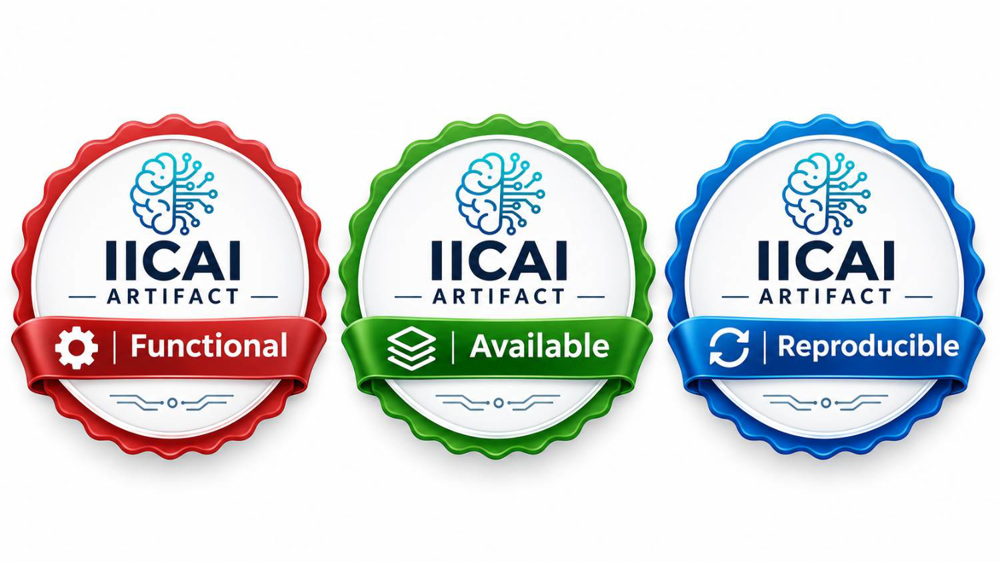
Each badge is evaluated according to its own criteria. An artifact may receive one or more badges depending on the evaluation outcome.
Artifact submissions are open to authors of accepted IICAI papers.
Authors must submit the accepted paper, artifact access information, and supporting documentation through the conference's designated submission system.
|
Event |
Date |
|
Artifact Registration Opens |
April 11, 2027 |
|
Artifact Submission Deadline |
May 2, 2027 |
|
Final Notification |
May 21, 2027 |
Submission System: To be announced.
Participation in artifact evaluation does not require an additional fee unless otherwise announced by the conference.
Artifacts submitted for evaluation will be treated confidentially unless the authors explicitly make them publicly available. Public release is required only for the Available badge.