

The IICAI Artifact Evaluation process assesses the accessibility, functionality, and reproducibility of research artifacts associated with accepted conference papers.
Artifact evaluation is conducted independently of the scientific peer-review process. Its purpose is not to reassess the novelty or scientific merit of accepted papers, but to determine whether their supporting artifacts meet the technical requirements for the corresponding evaluation badges.
The process emphasizes constructive feedback and communication between authors and evaluators, allowing technical issues to be addressed before final decisions are made.
Stage 1: Artifact Registration
Authors register their artifacts by providing the accepted paper, artifact description, access information, and execution requirements.
The AEC Chairs conduct an initial eligibility check and assign each artifact to reviewers with relevant technical expertise.
Stage 2: Initial Assessment (Kick-the-Tires)
Reviewers perform an initial examination to verify artifact accessibility, installation procedures, software dependencies, and basic functionality.
This stage is intended to identify technical issues that could prevent a thorough evaluation. Authors may be contacted to resolve installation or execution problems.
Stage 3: Technical Evaluation
Each artifact is evaluated by at least two independent reviewers.
Reviewers examine the artifact's documentation, completeness, consistency with the paper, and executability. For submissions seeking the Reproducible badge, reviewers also attempt to reproduce the principal experimental results.
Stage 4: Author Communication and Revisions
Reviewers may communicate with authors through the designated evaluation platform to request clarification, report technical problems, or seek additional execution instructions.
Authors may submit revised documentation, configuration files, scripts, or other minor technical corrections necessary for successful evaluation.
Revisions should address evaluation-related issues without fundamentally changing the research methodology or reported scientific results.
Stage 5: Final Decision
After reviewing the evaluation reports and any author responses, the AEC Chairs determine which badges, if any, should be awarded.
Authors receive a final notification together with relevant reviewer feedback.
Artifacts are assessed according to the following criteria:
|
Criterion |
Description |
|
Consistency |
Alignment between the artifact, research methodology, and claims presented in the paper. |
|
Completeness |
Availability of the essential components, including source code, models, datasets, configurations, and scripts. |
|
Documentation |
Clarity and adequacy of installation, configuration, execution, and evaluation instructions. |
|
Functionality |
Successful installation and execution with behavior consistent with the documented functionality. |
|
Reproducibility |
Independent reproduction of the paper's principal experimental findings. |
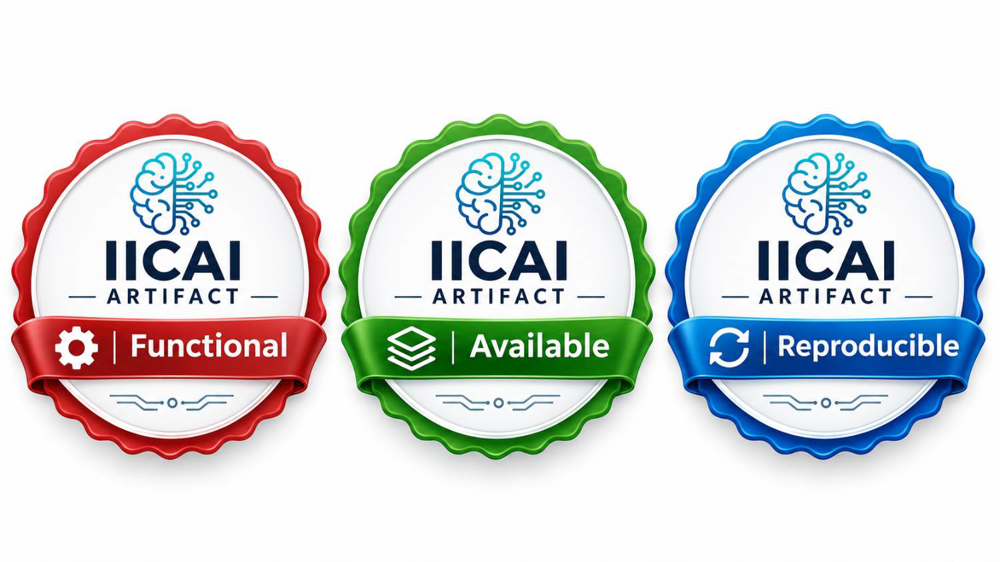
Functional Badge
The Functional badge is awarded to artifacts that are adequately documented, complete, consistent with the accepted paper, and successfully executable.
Reviewers must be able to install or access the artifact, execute its principal functionality, and confirm that its behavior is consistent with the provided documentation.
Receiving this badge does not necessarily imply that all experimental results have been reproduced.
Available Badge
The Available badge recognizes artifacts deposited in a publicly accessible, persistent archival repository.
Authors should provide an archived version of the artifact, preferably with a Digital Object Identifier (DOI), using services such as Zenodo or Figshare.
A source code repository without a persistent archived version may not be sufficient to qualify for this badge.
Reproducible Badge
The Reproducible badge is awarded when independent evaluators successfully reproduce the principal experimental results reported in the paper using the submitted artifact.
Exact numerical agreement is not always required, particularly for stochastic machine learning algorithms. Reasonable deviations arising from random initialization, hardware differences, or execution environments may be accepted if the reproduced results adequately support the paper's main conclusions.
AI research artifacts may require substantial computational resources, including GPUs, large datasets, specialized hardware, or extended training times.
Authors should clearly document these requirements and any associated limitations before evaluation.
The AEC may accept author-provided computational environments, reduced-scale demonstrations, or representative experiments when assessing functionality.
However, awarding the Reproducible badge requires sufficient independent experimental evidence supporting the main results of the paper.
Artifact evaluation is independent of the scientific peer-review process.
Each artifact is assessed by at least two reviewers.
Reviewer identities remain confidential to authors.
Conflicts of interest must be declared and appropriately managed.
Authors are provided opportunities to resolve technical issues during the evaluation period.
Badge decisions are based on documented technical evidence.
Non-public artifacts must not be disclosed or redistributed without author authorization.
Upon completion, authors receive the evaluation outcome and reviewer feedback.
Awarded badges will be displayed on the IICAI conference website. Their inclusion in published papers or associated digital library records will depend on the applicable publisher policies and approval procedures.