لطفا منتظر بمانید ...
0% Complete
صفحه اصلی
/
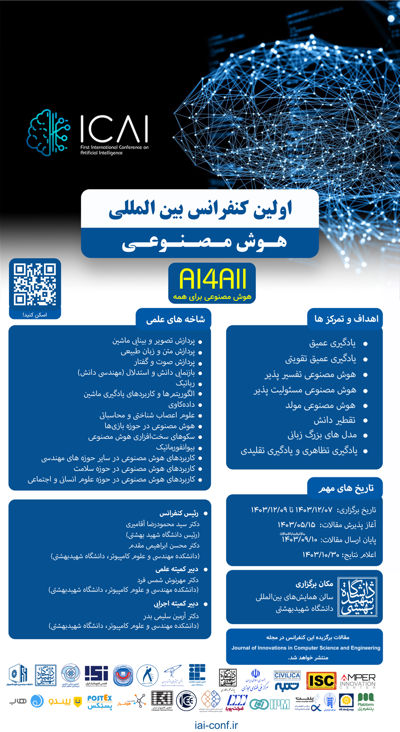
اولین همایش بین المللی هوش مصنوعی
Development and Validation of the Comprehensive Persian Social Perception Dictionary using a Semi-automated Method
نویسندگان :
Ali Heirani-Tabas
1
Pegah Nejat
2
Mehrnoosh Shamsfard
3
Sina Mahmudian
4
1- دانشگاه شهید بهشتی
2- دانشگاه شهید بهشتی
3- دانشگاه شهید بهشتی
4- دانشگاه شهید بهشتی
کلمات کلیدی :
Dictionary،Text Analysis،Social Perception
چکیده :
Social perception is among fundamental topics in social cognition, and is defined as attributing traits and characteristics to persons or social groups. Questionnaires constitute the traditional way to assess individuals’ perception of persons or groups. However, the rising number of psychological studies based on computerized text analysis necessitates the development of a dictionary to be used in social perception studies. Such a dictionary has been developed by Nicolas et al. (2021) in English using a semi-automated method. The present research aimed to develop a Persian dictionary using a similar method. Nicolas et al. used WordNet to expand a set of seed dictionaries (each dictionary represents one dimension used in social perception). In the present study, seed dictionaries were mapped and expanded using FarsNet. Next, participants were asked to report their perception of a set of social groups and persons. Due to the insufficient coverage of the primary dictionaries (40 percent), additional dictionaries were developed by expanding uncovered responses, resulting in 32 dictionaries with 8279 words overall. The coverage of the final set of dictionaries amounted to 80 percent for intergroup, and 86 percent for interpersonal perception data. Next, the reliability of dictionaries was assessed using word-embedding techniques. As expected, words in each dictionary bore higher similarity with each other than words from other dictionaries. To validate the dictionaries, participants were asked to report their perception of a set of social groups and persons on dimensions related to the dictionaries. As expected, dictionary coding based on directional scores predicted participants’ responses. Finally, as another method for validation, participants saw random sets of words from each of the dictionaries, and were instructed to rate how relevant each set of words were to each dictionary, based on their meaning. With a few exceptions, participants reported more similarity to the dictionary the words were originally taken from than to other dictionaries. To conclude, we found the coverage, reliability, and validity of the comprehensive Persian social perception dictionary to be adequate.
لیست مقالات
لیست مقالات بایگانی شده
A Multi-Dimensional Taxonomy and Practical Framework for MLOps Monitoring
Tina Hafezi - Sara Pour Faraj - Seyed Mohammad Amin Alemohammad - Niloofar Mirzaei Chahardeh
AdaKD-LoRA: Adaptive Knowledge Distillation with Low-Rank Adaptation for Rehearsal Free Continual Learning
Mohammad Ghabel rahmat - Samira Vejdanparast - Azam Bastan Fard - Abbas Jalilvand
NeuroPC-KGNN: A Causality-Driven Graph Neural Network Framework for Early Diagnosis of Parkinson’s Disease
Fatemeh Ahouz - Ahmad Ali Abin - Amin Golabpour
Efficient and Accurate Fairness Verification for Quantum Variational Circuits
Sajjad Hashemian Meymandi - Mohammad Saeed Arvenaghi
Predictive Modeling of Escherichia coli Growth: The Role of Key Cellular Features
Sajedeh Farahbod - Masoud Tohidfar
Soil Shear Strength Prediction Using Genetic-Optimized Boosting Machine Learning Models
Mohammadreza Ghadami - Ali Noorzad - Hamid Mohammadnezhad
Hybrid Deep Learning Models for Cardiovascular Disease Prediction: A Comprehensive Review of Convolution-Transformer Architectures
Ali Azimi Lamir - Masoud Bekravi - Babak Nouri Moghaddam
Simultaneous representation of decision variable and saccade direction in the parietal cortex
Zahra Naghdabadi - Amirreza Bahramani
Potential of machine learning algorithms for predicting the properties of medium-density fiberboard (MDF): preliminary results
Rahim Mohebbi Gargari - Ali Shalbafan - Seyed Jalil Alavi - Maryam Amirmazlaghni - Seyed Hamzeh Sadatnejad - Heiko Thoemen
From RLHF to DPO and Beyond: A Review of Preference Optimization Methods for Aligning Large Language Models
Poorya Saneei - Parham Rahimi - Behrouz Minaei-Bidgoli
بیشتر
ثمین همایش، سامانه مدیریت همایش ها و جشنواره ها - نگارش 44.11.0